What does Tri Hita Karana mean?
The phrase literally translates as "the three causes of well-being" or "the three reasons for prosperity". It is a central principle of Balinese Hinduism, the island's majority religion.
It describes three relationships which, together, make a life and a community prosperous and peaceful:
- Parahyangan: harmony between human beings and the divine;
- Pawongan: harmony among human beings, within society;
- Palemahan: harmony between human beings and their natural environment.
None of the three is enough on its own. Well-being comes from their balance: devotion that ignores the neighbours, or a close-knit community that exhausts its land, would remain incomplete.
Where can you see it in Balinese life?
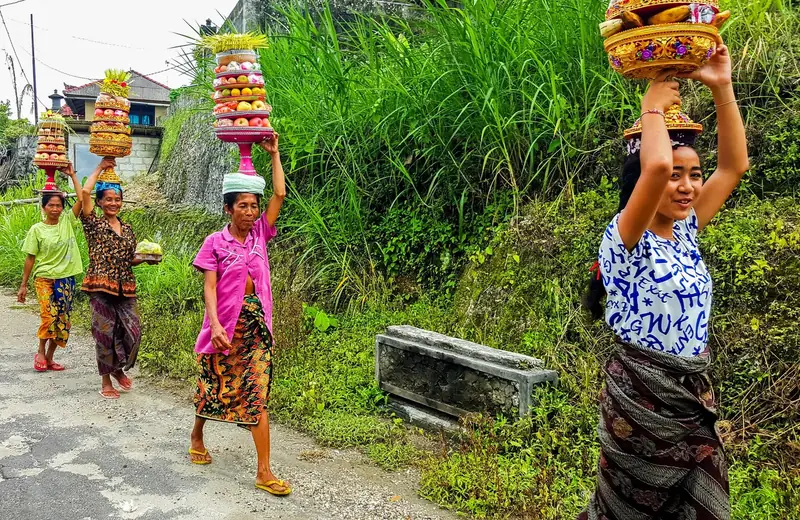
The principle guides many aspects of daily life: rituals and offerings (the bond with the divine), the mutual help known as gotong royong (the bond with others), and also spatial organisation in Balinese architecture and the management of natural resources (the bond with nature).
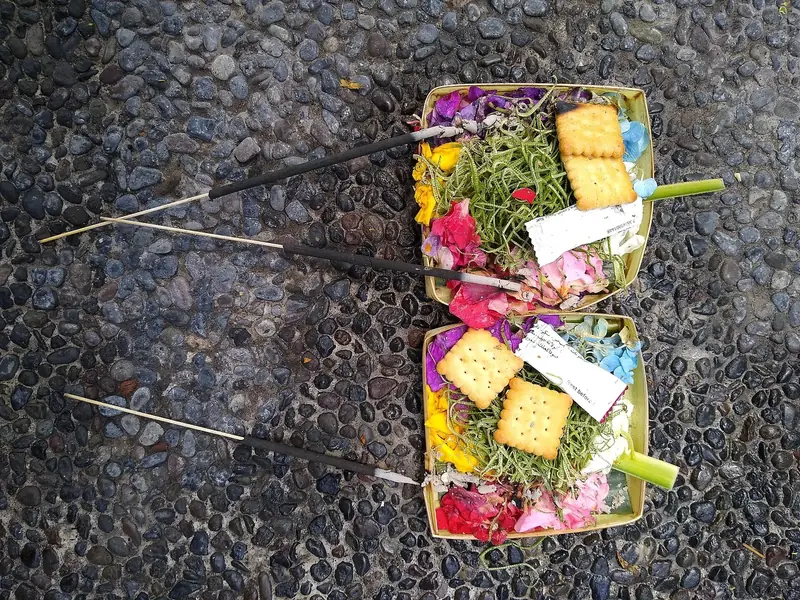
Offerings are the most visible example. Family shrines receive them every day, usually in the morning and again in the late afternoon, and more elaborate offerings are prepared for important days in the calendar.
The subak: a World Heritage Site named after Tri Hita Karana
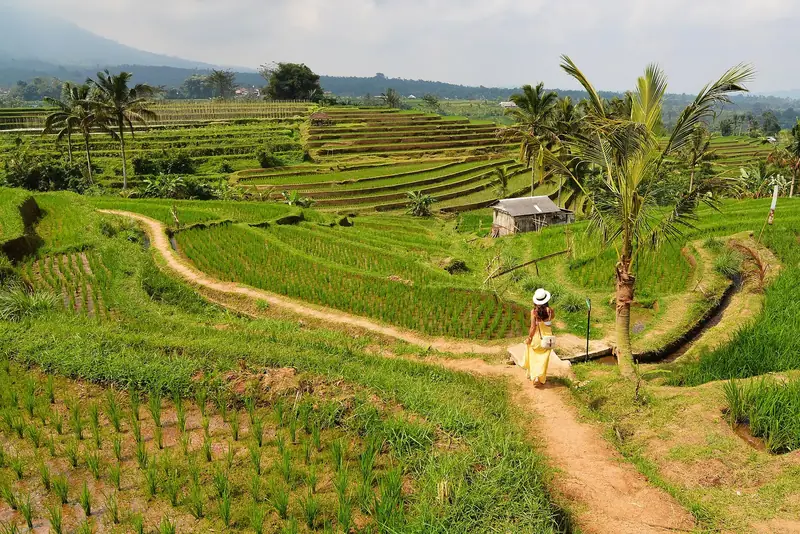
Outside Bali, the principle is best known through the subak, the island's cooperative irrigation system for rice fields. Farmers in the same subak share water from a single source through jointly managed weirs and canals, organised around "water temples" where rituals set the rhythm of farming.
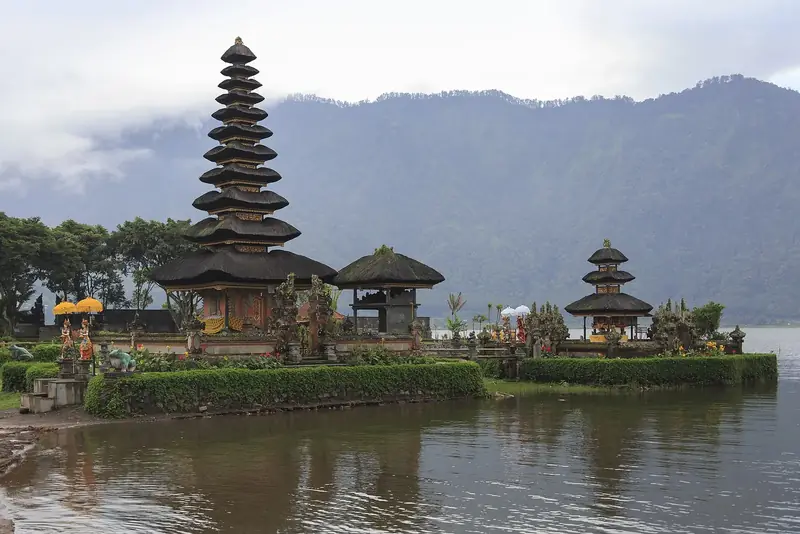
On 6 July 2012, UNESCO inscribed this system on the World Heritage List under an explicit title: "Cultural Landscape of Bali Province: the Subak System as a Manifestation of the Tri Hita Karana Philosophy". The site brings together five areas, including the landscape of Catur Angga Batukaru (which includes the famous Jatiluwih terraces), the royal temple of Taman Ayun and the supreme water temple, Pura Ulun Danu Batur, on the shore of Mount Batur's crater lake.
The American anthropologist J. Stephen Lansing devoted much of his work to these water temple networks, showing how the ritual coordination of planting also answers very concrete needs, such as sharing water and controlling pests.
An ideal… and an image
It would be wrong to present Bali as a society that lives Tri Hita Karana perfectly. Since the late 20th century, Indonesian authorities have also promoted this image of a harmonious traditional community, particularly to an international audience and to boost the island's appeal to tourists.
The principle remains a living ideal, debated and sometimes tested, for example by land and tourism pressure on the rice fields. That is precisely what makes it interesting: a compass, not a backdrop.
Drawing on it without appropriating it
You do not need to be Balinese or Hindu to find these three relationships a useful lens. They invite you to ask where an imbalance lies, without pretending to reproduce rites that have their meaning within a specific community and religion.
A few questions, inspired by these three harmonies, that you can ask yourself:
- What is greater than me: what gives meaning to my days right now? When did I last take time to give thanks?
- Other people: which relationship weighs on me, or is missing? What small gesture could I make towards someone today?
- Nature: when did I last spend time outdoors, without a screen? What do I consume without thinking?
These questions are not a Balinese ritual: they are avenues for reflection that Artha can help you explore.
Frequently asked questions
How do you pronounce Tri Hita Karana?
Roughly "tree hee-ta ka-ra-na", with a very soft "h".
Is Tri Hita Karana a religion?
No. It is a philosophical principle from Balinese Hinduism that shapes religious practice, social organisation, architecture and farming.
Can you visit the subak rice fields?
Yes. The Jatiluwih terraces, in the Catur Angga Batukaru landscape, are part of the UNESCO-listed site and are open to visitors. Please stay on the paths and respect the farmers' work.
Sources
- UNESCO, "Cultural Landscape of Bali Province: the Subak System as a Manifestation of the Tri Hita Karana Philosophy" (inscribed 2012)
- Wikipedia, "Tri Hita Karana" — accessed 19 November 2026
- Wikipedia, "Subak (irrigation)", World Heritage Site status section — accessed 19 November 2026
- Wikipedia, "Balinese Hinduism", Tri Hita Karana and Offerings sections — accessed 19 November 2026
This article is a general introduction, written with respect for Balinese traditions and based on the sources cited. It does not replace the teaching of a priest or a balian, or the advice of a health professional.