A 210-day cycle
The Pawukon is a 210-day calendar rooted in Hinduism as practised in Bali. Its cycles are not numbered: there is no "year one", the same 210-day cycle simply repeats.
Balinese people use it alongside a second calendar, the lunar Saka calendar, which sets for instance Nyepi, the Day of Silence, at the start of the Saka year, usually in March.
Ten weeks running at the same time
The Pawukon's distinctive feature: it runs ten "weeks" of different lengths, from 1 to 10 days, at the same time. The first day of the cycle is the first day of all these weeks at once.
The ones most used in daily life are:
- the 7-day week (saptawara): Redite, Soma, Anggara, Buda, Wraspati, Sukra, Saniscara, which match our days from Sunday to Saturday;
- the 5-day week (pancawara): Paing, Pon, Wage, Kliwon, Umanis;
- the 3-day week (triwara): Pasah, Beteng, Kajeng.
Because 210 cannot be divided by 4, 8 or 9, some days in those weeks are repeated so that everything comes out even at the end of the cycle.
The 30 wuku
Each of the thirty 7-day weeks has a name: these are the wuku. The cycle begins with Sinta, Landep, Ukir… and the 11th week, Dungulan, is the week of Galungan, followed by the week called Kuningan.
When a day is described as "Buda Kliwon Dungulan", three pieces of information are combined: the day of the 7-day week (Wednesday), the day of the 5-day week (Kliwon) and the wuku (Dungulan).
Galungan and Kuningan: 2027 dates
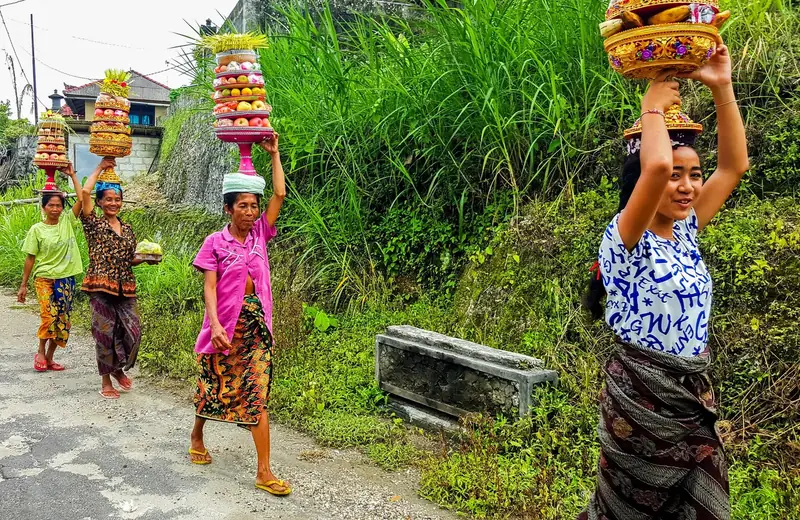
Galungan, the most important festival in this calendar, celebrates the victory of dharma (righteous order) over adharma. It falls on the Wednesday (Buda) Kliwon of the 11th week, Dungulan. According to tradition, the spirits of the ancestors come down to visit their families, who welcome them with prayers and offerings. Penjor, tall decorated bamboo poles, line the roads.
Kuningan, ten days later, marks their return.
Because the cycle lasts 210 days, Galungan comes round roughly every seven months, sometimes twice in the same year:
- Galungan: Wednesday 13 January 2027; Kuningan: Saturday 23 January 2027;
- Galungan: Wednesday 11 August 2027; Kuningan: Saturday 21 August 2027.
These dates follow directly from the 210-day cycle and match published calendars. Local ceremonies may vary from one village to another.
Other special days
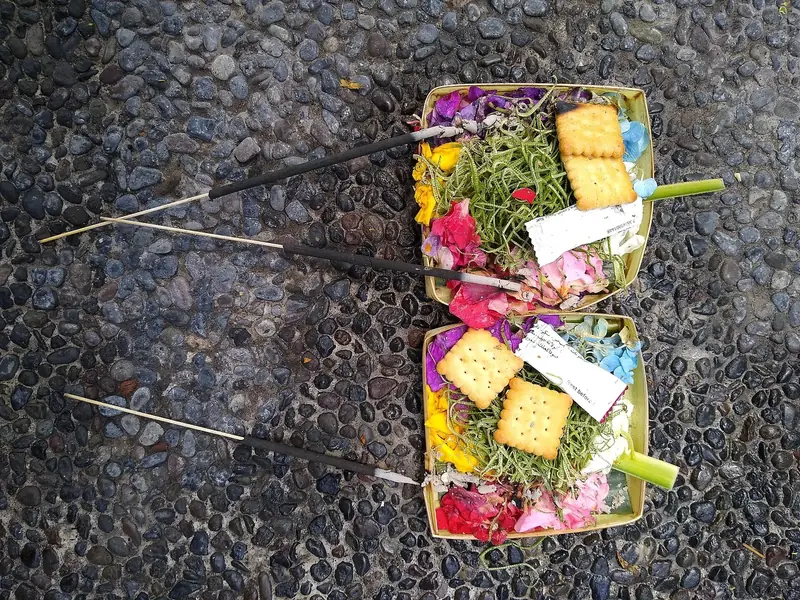
Some combinations come round regularly and call for more elaborate offerings: Kajeng Kliwon (every 15 days), the Tumpek days (every Saturday Kliwon, i.e. every 35 days), Pagerwesi (the 4th day of the cycle) and the day of Saraswati, goddess of learning, on the last day of the cycle, as well as the full moon (Purnama) and the new moon (Tilem), which belong to the lunar calendar.
How Artha uses the Pawukon
Every day, Artha's daily guidance is attuned to the Balinese day: the current wuku, the phase of the moon and any festivals. It is not a prediction: it is a way of giving the day a tone, inspired by the island's rhythm.
Frequently asked questions
Why does Galungan change date every year?
Because it follows the Pawukon, a 210-day cycle, rather than the 365-day solar year. It therefore comes round roughly every seven months.
Can tourists attend Galungan?
The streets decorated with penjor are visible to everyone. To enter a temple during a ceremony you need appropriate dress (sarong and sash) and great discretion; some ceremonies are reserved for worshippers.
Does Nyepi follow the Pawukon too?
No. Nyepi, the Day of Silence, marks the start of the Saka year, which follows a lunar calendar; it usually falls in March.
Sources
- Wikipedia, "Pawukon calendar" — accessed 19 November 2026
- Wikipedia, "Galungan" — accessed 19 November 2026
- Wikipedia, "Balinese Hinduism", Galungan and Kuningan, Nyepi, Other festivals sections — accessed 19 November 2026
- Nusa Penida (local site), 2027 ceremony calendar: Galungan 13 January and 11 August, Kuningan 23 January and 21 August — accessed 19 November 2026
This article is a general introduction, written with respect for Balinese traditions and based on the sources cited. It does not replace the teaching of a priest or a balian, or the advice of a health professional.